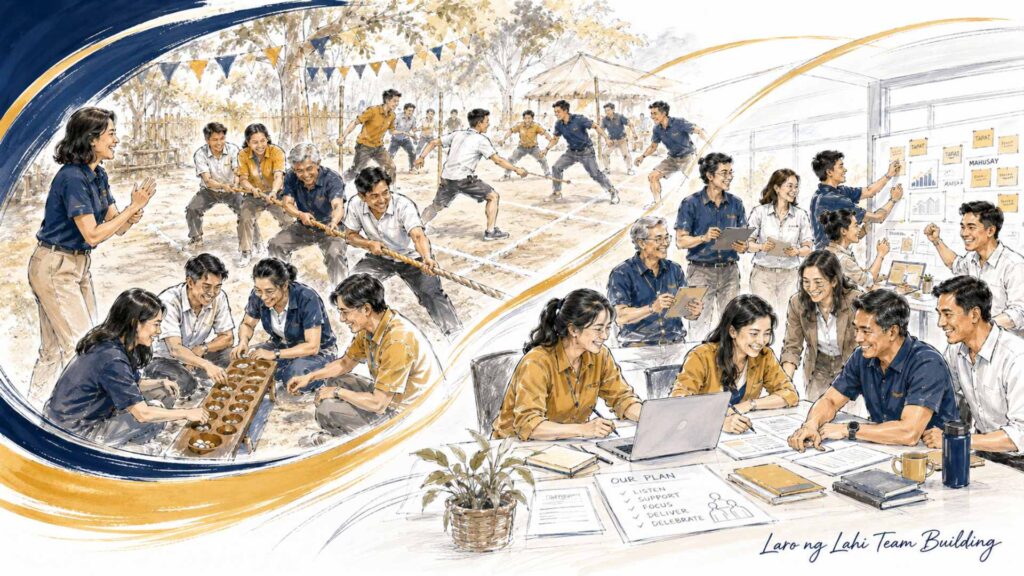

Larong Pinoy for team building is powerful because it feels familiar, playful, and low-barrier—people join fast, walls drop faster. In this article, Wilrose Valerio lists 20 classic games and explains how they build team spirit, synergy, and collaboration. Try one game shows up best, and if you want a smoother run with stronger takeaways, have a facilitator guide the flow and debrief.
Mga Larong Pinoy are Filipino traditional games played since the 1980s and 1990s, but sadly, due to modern technology, most young people today are unable to play some of them and most of it had been long forgotten.
The word “laro” in Filipino refers to any type of recreational activity. Larong Pinoy’s materials are typically indigenous and only available locally.
Even though Larong Pinoy is no longer widely practiced, many schools in the Philippines are still attempting to revive and teach it, especially at the elementary level.
These games can also find new life in the workplace. In team building workshops inspired by Filipino games, familiar activities can be redesigned to help people practice trust, coordination, communication, strategy, and shared responsibility. The games bring back childhood memories, but thoughtful facilitation connects the experience to how people work together today.
Why Larong Pinoy?
Larong Pinoy when incorporated into team building will not only make it more fun but can bring Filipinos back to the old days.
Old days create feelings of warmth and remembrance of childhood or teenage life. Remembering helps with the enthusiasm of the team member.
What about those who aren’t Filipino? It may allow them to share the Pinoy culture, and if they are managers or bosses, they will understand their employees and the community they are in charge of better.
Larong Pinoy teaches a lot about teamwork, trust, team synergy, team spirit, and more!
We could add a few tweaks and it can work as a design for learning key competence and development that a team needs.
List of Mga Larong Pinoy
- Kadang-kadang
- Palosebo
- Agawan Buko
- Luksong Tinik
- Luksong Baka
- Pabitin
- Pukpok Palayok
- Tumbang Preso
- Patintero
- Sipa
- Langit Lupa
- Jack En Poy
- Agawang Base
- Luksong Lubid
- Araw Lilim
- Agawang Sulok
- Bahay Kubo
- Bulong Pari
- Agawang Panyo
- Pepsi 7-up
Want your team building to create real change after the games end?
Kadang Kadang
Kadang-kadang is a relay game, an outdoor game played on bamboo stilts. It is also known as Tiyakad in tagalog and was first played in Cebu in the year 1969.
Palosebo
Palosebo, a traditional Filipino game in which players compete to see who can climb the highest up a slippery bamboo pole, could be a relay and speed game.
Agawan Buko
Agawang buko makes use of an unpeeled coconut. The coconut must be difficult to grasp for the game’s participants. The player who picks up the most coconuts is the winner!
Luksong Tinik
Luksong Tinik is a team game in which the leader is referred to as a ‘nanay,’ and the rest of the team members are referred to as children. They will form a line and jump to the height of the hands placed on top of the other without touching them.
Luksong Baka
Luksong Baka is a traditional Filipino game that originated in Bulacan, in which players jump over the person known as the “Baka” or “Taya” (It)
Pabitin
Pabitin involves suspending a lattice of bamboo sticks (called balags) in the air with string. Prices are strung across the lattice. It is suspended in such a way that it can be quickly lowered and raised.
Pukpok Palayok
Pukpok Palayok also known as Hampas-Palayok. “Pukpok” and “hampas” are Tagalog words meaning ‘to hit.’ The player is blindfolded and spins three to five times before letting it hit the palayok or a pot, while those around could guide or distract the player.
Tumbang Preso
Tumbang preso, also known as tumba lata (“knock down the can”) or bato lata (“hit the can [with a stone]”), is a traditional Filipino children’s game. The game involves throwing a slipper at a can or bottle that one player tries to guard (the tayà).
Patintero
Patintero, also known as harangang-taga or tubigan. One team serves as the taggers, while the other serves as the runners. Taggers will be the ones who block the runner so that they do not get a pass on them.
Sipa
Sipa is a game that can be played both indoors and outdoors. One or two players juggle a metal washer, a ball, or a cluster of rubber bands with their feet. It looks like volleyball but not using a hand like in soccer.
Langit Lupa
Langit Lupa is a variation on a running-around game where one is considered ‘taya’ (It) or untouchable if they are in an elevated place. Taya chants a rhyme, at the end of which everyone must run to a new elevated position while avoiding being tagged.
Jack En Poy
Jack En Poy is the local version of the rock, paper, and scissor game. The players will sing the lyric:
Jack ‘n’ Poy, hale-hale-hoy! (Jack and Poy, hale-hale-hoy!)
Sinong matalo s’yang unggoy! (Whoever loses is the monkey!)”
Agawang Base
Agawan Base is a strategy game where each base has an equal number of members. The base will be secured by one person. Others may leave the base to pursue opposing team members or to take the opponent’s base.
Luksong Lubid
Luksong Lubid is a skipping game using a jump rope. Teams should score the most points by skipping or jumping over the rope while it is continuously turned over the heads and under the feet of the players.
Araw Lilim
Araw Lilim, also known as sun and shade, is a game in which the ‘It’ or tagger attempts to tag or touch any of the players who are in direct contact with the light.
Agawang Sulok
Agawang Sulok, all players except one (the tagger) remain in the corner and on the bases. The tagger stands in the middle of the ground. The players in the corners will try to swap places by darting across the field. The tagger must try to secure a vacant corner or base by rushing to it.
Bahay Kubo
Bahay kubo game is a song game where you sing and play with your team that consists of 4 team members. The team will perform a hand clapping “routine” while singing the “bahay kubo,” and each pair exchanges “routines” with the other in the middle of the song.
Bulong Pari
Bulong Pari is a whispering game known as “Honghonganay” in the Visayan region. It requires two teams with at least 10 to 20 members each. Team A’s leader will approach the priest and whisper the name of one of Team B’s members. The priest then exclaims, “Lapit! ” (“Approach”) to summon one Team B player. When the name whispered by team B is the same name whispered by team A, team B wins and vice versa.
Agawang Panyo
Agawang Panyo is a game in which an umpire holds a handkerchief high and two teams compete to take the handkerchief. Each team member has a corresponding number, and when the umpire calls the number, they will be the one to have a chance to take the handkerchief.
Pepsi 7-Up
Pepsi 7-Up is a game where the ‘Taya’ is positioned opposite the players. When he says Pepsi, the players rush to get as close to the ‘Taya’ as possible. When the ‘Taya’ says 7-Up, the players come to a halt, and when a player reaches the ‘Taya’ and taps his shoulder. The players must return to their base or risk being captured and becoming the next ‘Taya’.
You can enrich these games.
Note that these games are more exciting than imported team-building games like Trust Fall and Spider Web. With creativity, we can turn each of these games into team-building activities that target specific competencies.
We believe that these games were invented by our elders to teach us lessons about working with others. You can use these games the next time you are tasked to facilitate a team building program for your company.
So don’t miss out and try some of these games with us!