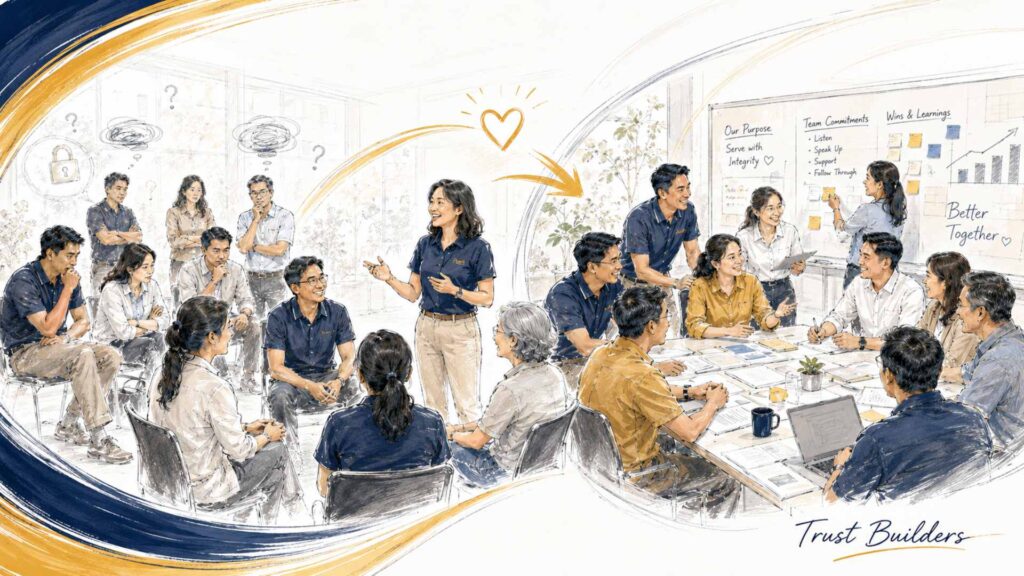
Trust Builders
A team building workshop for teams that need to rebuild trust, reduce second-guessing, and work with more confidence together.
Some teams do not look broken. People attend meetings, send updates, and finish tasks. But underneath the activity, there is hesitation.
People double-check because they are not sure commitments will be kept. They stay quiet because honesty feels risky. They protect themselves because mistakes are not safe. They wait for the leader because they are not sure the team will back them up.
Trust Builders helps your team see where trust is breaking — and practice the behaviors that make people easier to believe, easier to count on, and safer to work with.
Why Does Everything Feel Slower When Trust Is Low?
Low trust does not always look like conflict.
Sometimes, it looks like checking everything twice.
A leader asks for an update, but still follows up with three other people because they are not sure the answer is complete. A teammate says, “I’ll handle it,” but everyone quietly prepares a backup plan. A department promises to send the file by Friday, but the receiving team does not relax because they have been disappointed before.
The work still moves.
But it moves with friction.
People spend extra time verifying, reminding, protecting, explaining, and waiting. Meetings become longer because people need to defend their side. Decisions move slower because nobody wants to take a risk. Honest feedback comes late because people are unsure how it will be received.
That is the trust tax.
The team pays for it every day, even when nobody names it.
Where Does Trust Break?
Trust usually breaks in small places before it becomes a big issue.
It breaks when people are not sure they can believe what is being said. It breaks when commitments are made but not kept. It breaks when honesty feels unsafe. It breaks when people sense that others are protecting themselves more than they are protecting the team.
One way to see trust is simple: people ask four quiet questions about one another.
Can I believe what you say?
Can I count on what you do?
Can I be honest with you?
Are you helping the team win, or mostly protecting yourself?
These questions are not usually spoken out loud. But people answer them through experience. Every meeting, handover, promise, mistake, delay, and difficult conversation teaches the team whether trust is growing or shrinking.
Trust Builders helps the team see these patterns clearly.
Not to blame people.
To rebuild what makes work easier, faster, and safer.
Can People Believe What We Say?
Trust begins with believability.
In some teams, people speak carefully because they do not want to be wrong. They give safe updates. They soften bad news. They say, “Almost done,” even when the work is still far from ready. They say yes too quickly because saying no might disappoint someone.
At first, this may seem harmless.
But the team slowly learns to doubt the message.
People begin to ask follow-up questions not because they are curious, but because they are unsure. Leaders ask for proof. Teammates read between the lines. Customers hear promises the team may not be ready to keep.
When believability is weak, communication becomes heavy.
People need more explanations, more meetings, more reminders, and more reassurance before they can move. The team loses speed because words no longer carry enough weight.
A trust-building team learns to speak with more clarity and courage. People say what is true earlier. They name risks before they become excuses. They avoid promises they cannot keep. They make it easier for others to believe them because their words become more honest, specific, and useful.
Can People Count on What We Do?
Trust also grows through follow-through.
A person may be credible in a meeting, but trust still drops when commitments disappear after the meeting ends. Someone promises to send the update today, but sends it tomorrow. Someone agrees to own a task, but waits until the leader asks again. Someone says, “Noted,” but nothing changes.
Nobody may intend to break trust.
But repeated small failures teach the team to expect disappointment.
That is when people start working around each other. They create backup plans. They copy more people than necessary. They follow up earlier than needed. They check not because the work requires it, but because experience has taught them not to assume.
This is exhausting.
A reliable team does not need constant chasing. People close loops. They update before being asked. They keep small promises because they understand that every promise trains the team to either trust or doubt them.
Trust Builders helps participants see that reliability is not built through big speeches. It is built through repeated moments where people do what they said they would do.
Especially when no one is watching.
Can People Be Honest Without Fear?
Some teams are polite because they are healthy.
Other teams are polite because honesty is risky.
There is a difference.
When psychological safety is low, people edit themselves. They do not ask questions because they might look incompetent. They do not admit mistakes because they might be blamed. They do not challenge ideas because someone might take it personally.
So the team becomes quiet.
Not because there is nothing to say.
But because people have learned that silence is safer.
This kind of silence is costly. Problems are discovered late. Weak plans move forward because nobody challenged them early. People agree in the room, then resist outside the room. The team protects comfort, but sacrifices clarity.
Trust Builders helps people practice safer honesty. That means asking questions without shame, raising concerns without attacking, admitting mistakes before they become bigger, and giving feedback in a way that protects both the work and the relationship.
Trust does not mean everyone always agrees.
It means people can tell the truth and still remain on the same team.
Are People Protecting Themselves or Helping the Team Win?
This is often where trust breaks fastest.
People may be capable. They may be reliable. They may even be pleasant to work with. But when others feel that someone is mostly protecting their own image, convenience, status, or department, trust goes down.
You see it when people avoid responsibility by saying, “Wala sa amin yan.” You see it when someone hides a mistake because they are afraid of blame. You see it when a department wins its own argument while the customer loses. You see it when people care more about looking right than making the work right.
This is self-protection.
And self-protection spreads.
When one person protects themselves, others begin to protect themselves too. Soon, the team becomes careful, political, and slow. People choose safe moves over useful moves. They ask, “How do I avoid blame?” instead of “How do we solve this together?”
A trust-building team shifts the question.
Not “How do I protect myself?”
But “What does the team need from me so we can win?”
That shift changes behavior. People become more willing to help, clarify, admit, repair, and own their part. They stop treating trust as a feeling and start practicing it as a responsibility.
What Shift Are We Trying to Create?
Trust Builders helps teams move from second-guessing to confidence.
That is the practical shift.
When trust grows, people spend less energy protecting themselves and more energy doing the work. Leaders do not need to inspect everything. Teammates do not need to over-explain every request. Decisions can move faster because people believe the conversation, the commitment, and the intention behind the action.
The team becomes easier to work with.
People say what they mean. They do what they promise. They raise issues early. They repair mistakes faster. They focus less on blame and more on the shared result.
This does not happen because of one lecture about trust.
It happens when the team sees where trust is breaking and practices the small behaviors that rebuild it.
What Does Winning Look Like After Trust Builders?
Winning looks like a team that can count on each other again.
People give clearer updates. They keep commitments more consistently. They raise concerns earlier. They ask for help before the work gets damaged. They stop hiding behind politeness, silence, or self-protection.
The leader feels the difference too.
There is less chasing. Less guessing. Less emotional weight. Less need to verify every small thing because people are beginning to protect the work together.
That is what trust makes possible.
Not just better relationships.
Better work.
Trust Builders helps your team rebuild the confidence to speak honestly, follow through clearly, and move together with less friction.
Ask About Trust Builders
You do not need to have everything final before you inquire.
Your date, venue, number of participants, and exact goals may still change. That is okay.
Tell us what you already know about your team and what you want to improve. If people are second-guessing each other, avoiding honest conversations, missing commitments, or relying too much on the leader to check everything, Trust Builders may be the right workshop to explore.
We will help you see if this fits your team’s situation.
Frequently Asked Questions About Trust Builders
Who is Trust Builders best for?
Trust Builders is best for teams where people need to work with more confidence, honesty, and follow-through.
It is a good fit when people second-guess each other, avoid difficult conversations, miss commitments, protect themselves, or depend too much on the leader to check and remind everyone.
What workplace issues can Trust Builders help address?
Trust Builders can help address guarded communication, slow decisions, weak follow-through, over-checking, fear of speaking up, unclear commitments, and low confidence among teammates.
These issues often appear as delays, repeated reminders, defensive behavior, or meetings where people agree in the room but hesitate after.
Is this only about relationships?
No. Trust affects relationships, but it also affects work.
When trust is low, people spend more time checking, explaining, defending, waiting, and protecting themselves. When trust improves, work can move faster because people are easier to believe, easier to count on, and safer to be honest with.
What does trust look like at work?
Trust at work looks like people saying what is true, doing what they promised, raising issues early, admitting mistakes, asking for help, and focusing on the shared result instead of protecting only themselves.
It is built through small behaviors repeated every day.
Do you use the Trust Equation in this workshop?
Yes, we may use the Trust Equation as a simple lens to help the team see where trust breaks.
In practical terms, we help participants explore four questions: Can people believe what we say? Can they count on what we do? Can they be honest with us? Do they feel we are helping the team win, not only protecting ourselves?
What happens during Trust Builders?
Participants go through facilitated activities, reflection, and team conversations that make trust visible.
The workshop helps the team see how they communicate, follow through, respond to mistakes, handle honesty, and protect or weaken trust during daily work.
Can Trust Builders be customized?
Yes. We can customize Trust Builders based on your team size, schedule, venue, goals, and current workplace situation.
Some teams need safer conversations. Some need stronger follow-through. Some need to rebuild confidence after repeated disappointments. We shape the workshop around what your team needs most.
Can this be done indoors or outdoors?
Yes. Trust Builders can be facilitated indoors, outdoors, or in a mixed format.
Indoor sessions work well for reflection, dialogue, and team agreements. Outdoor or activity-based formats work well when the team needs movement, energy, and shared experience before deeper conversations.
How long is the workshop?
Trust Builders can be designed as a half-day, one-day, or custom-format workshop.
A half-day works well for one focused trust issue. A one-day workshop gives more room for activities, reflection, and practical commitments. A custom format may be better for larger groups or teams with deeper concerns.
How do we know if Trust Builders is right for us?
Trust Builders may be right for your team if people are working together, but not fully confident in one another.
If your team needs more honesty, clearer commitments, stronger follow-through, and less second-guessing, this workshop is worth exploring.
About Team Bayanihan
Trust Builders is facilitated by Team Bayanihan, a team building facilitation company that designs purposeful team building experiences for Filipino organizations.
Our work helps teams move beyond fun and games, so people can practice trust, collaboration, accountability, malasakit, and shared wins at work.
Learn more about Team Bayanihan.