
Mika is a CEO in Manila. Sharp, decisive, respected.
She blocks a full morning for a strategy meeting because she wants the team to leave with three calls: what to focus on, what to stop, and who owns the next moves.
It’s the fourth meeting about the same topic.
By 9:12 AM, people are still arriving. Someone apologizes for traffic. Someone says, “Just five minutes, the others are on the way.” Mika smiles, because she doesn’t want to look intense on a Monday.
Then the updates begin.
One leader gives a long explanation. Another adds context. A third starts defending why last month’s plan “didn’t fully land.” Everyone sounds responsible. Everyone sounds busy.
Mika listens, nods, and tries to steer the room back.
“So what are we deciding today?” she asks.
A manager answers, “We just want to align first.”
You’ve heard that line, right?
Alignment is not a decision. Alignment is often what people say when they don’t want to make a call in front of the wrong people.
By 11:30, the room is tired. The meeting ends with a familiar promise: “Let’s meet again next week with a clearer proposal.”
Mika walks out with a clean calendar and a messy mind.
And nothing changes.
Why This Happens Here
Meetings in the Philippines have a special kind of gravity because we bring a few habits into the room that quietly shape what’s allowed. We respect hierarchy. We protect relationships. We avoid embarrassment. We’d rather soften the truth than risk friction.
Those are good human instincts.
But inside a meeting, they can turn into a trap. The conversation stays polite, the tone stays safe, and the work stays undecided.
So we talk.
We explain. We update. We add context. We agree quickly. Then we leave with nothing that actually moves Monday.
The Meeting That Looks Productive, But Isn’t
A lot of meetings are smooth.
No one argues. No one gets called out. The boss looks satisfied. The team looks cooperative. The meeting feels “professional.”
But a smooth meeting can still be a useless meeting.
If the meeting produces no decision, no owner, no deadline, and no next check-in, it did not create progress. It only created the feeling of progress.
That feeling is expensive.
It costs time, attention, and momentum. It also teaches people a bad habit: show up, talk, survive, repeat.
What World-Class Actually Means
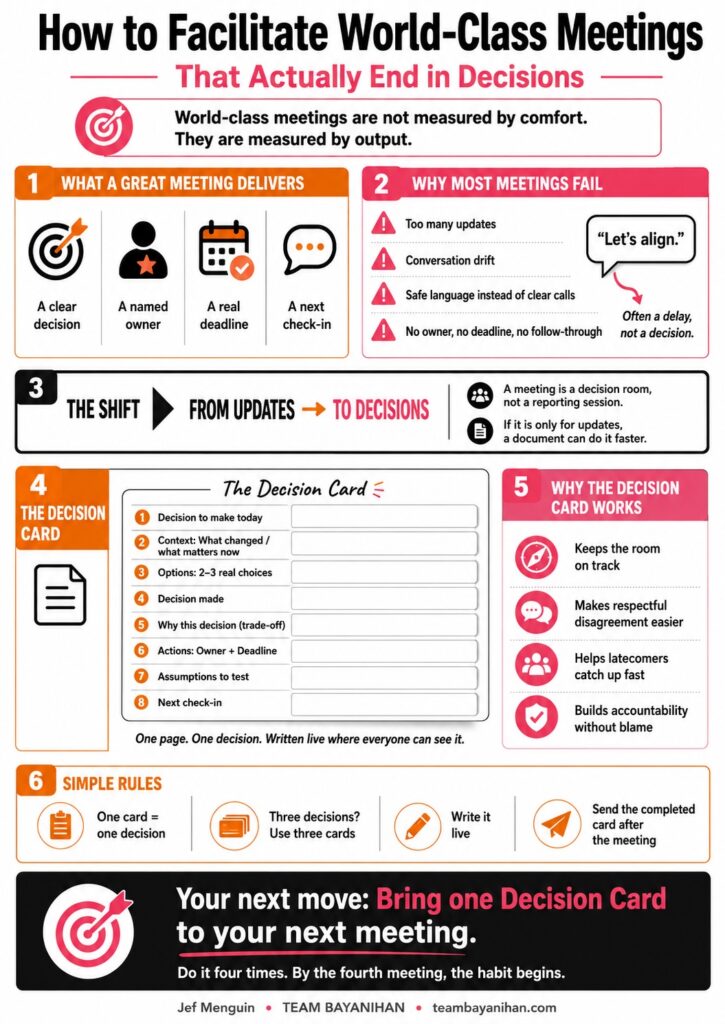
A world-class meeting is not measured by comfort.
It’s measured by output. When the meeting ends, you can point to something visible and say, “This is what we decided, and this is what happens next.”
Think of it like a delivery receipt.
You don’t rate a courier based on how friendly they were. You rate the courier based on whether the package arrived where it needed to go, intact, and on time. Meetings are the same.
So here’s the simplest definition.
A world-class meeting ends with a decision that can be repeated, an owner who can be named, a deadline that can be checked, and a next step that reduces confusion.
The Real Enemy Is Drift
Most meetings do not fail because people are lazy.
They fail because the conversation has no guardrails. The group starts with one topic, then slides into another, then responds to the loudest voice, then runs out of time.
Drift looks harmless in the moment.
Someone raises a related issue. Another person shares a story. A third person adds a concern “for awareness.” Suddenly the meeting becomes a highway with no exits.
In Manila, drift also hides behind respect.
When the most senior person speaks, others follow—even if the comment is not a decision. When no one is sure who has the authority to decide, everyone talks like advisers and no one talks like owners.
You can feel the moment it happens.
People start using safe language. “Let’s align.” “Let’s revisit.” “We’ll socialize this.” These are not evil phrases. They’re just often used to avoid making a call.
And when the room avoids the call, the work stalls outside the room.
From Updates to Decisions
A meeting is a decision room, not a reporting session.
Reporting matters, but it does not require a meeting. If the goal is only to share updates, a document can do it faster and with less interruption.
A meeting earns its cost when it produces a choice.
A choice about priorities. A choice about trade-offs. A choice about who owns what. A choice about what will happen next, and when.
Now let me show you the contrast.
Mika runs the same strategy meeting the following week, but with one change. Before anyone starts updating, she says, “By the end of this meeting, we will decide our top three priorities for Q1. If we can’t decide, we will decide what information we need to decide.”
The room gets quieter.
Not because people feel controlled, but because people finally know what the meeting is for.
That’s what decision-driven meetings do in the Philippines.
They reduce the invisible burden of interpretation. They protect relationships by making accountability less personal. They make the call clear without making the culture harsh.
Do you want that kind of meeting?
Good. Let’s build it.
The Decision Card
Think of it like a boarding pass.
It tells you where you’re going, what gate you need, and what time you have to be there. Without it, you can still hang around the airport. You can still talk. You can still “align.” But you won’t go anywhere.
A meeting without a decision card is the same.
So here’s the tool: The Decision Card. One page. One decision. Written live, while everyone can see it.
At the top, you write the line that forces clarity:
Decision to make today: ____________________
This becomes the guardrail. When the conversation drifts, you don’t argue. You just point back to the top of the card.
“That’s useful context. Does it help us decide this?”
The card also gives you the flow.
Not a fancy framework. Just a natural sequence that matches how decisions actually get made.
What to put on the card (and how it guides the meeting)
Start with Context.
This is where Manila meetings usually get stuck, because context becomes storytelling. People explain too much to sound safe. The card prevents that by limiting the space.
What changed / what matters now (3 bullets):
Then move to Options.
Not ten options. Not brainstorming. Real options.
Options we are choosing between (2–3):
This is where the meeting becomes adult.
Because options force trade-offs. And trade-offs force leadership.
Then you write the Call.
Not “aligned.” Not “noted.” Not “we will consider.” A clear call.
Decision made: ____________________
And right below it, the sentence that prevents amnesia:
Why this decision (the trade-off): ____________________
That “why” matters in Philippine workplaces.
It reduces the guessing game. It stops people from decoding the boss’s mood. It gives the team a shared story they can repeat without fear.
Then you lock Actions.
This is where many meetings die. Not because people don’t care, but because ownership gets vague.
So the card makes it concrete.
Actions (Owner + Deadline):
- ____________________ / ____________________
- ____________________ / ____________________
Finally, you add Assumptions to test.
This is what separates a decision from a wish.
It gives the team permission to learn, adjust, and improve without shame.
Assumptions we are betting on:
And you end with Next check-in.
Because decisions don’t survive without a return point.
Next check-in (date/time): ____________________
That’s the whole card.
Simple, visible, repeatable.
How the Decision Card changes meetings
This tool works well here because it removes a few hidden burdens.
It reduces the need to “read between the lines,” which is a quiet tax in many Filipino teams. It makes it easier to disagree respectfully, because you’re reacting to written options, not attacking a person. It also helps the most senior leader lead without dominating, because the card carries the structure.
It also solves lateness in a practical way.
When the card is already on the board, latecomers can catch up without the team rewinding the whole conversation. They can see the decision, the options, and the direction instantly.
And it builds a meeting culture without making a speech about culture.
People repeat what works.
One meeting, three decisions? Use three cards.
This is the rule that keeps the meeting clean.
A card is a decision.
If you try to fit three decisions on one card, you will rush, blend topics, and lose the discipline that makes the tool powerful.
So if you walk into a meeting and you already know there are three decisions to make, print three cards or open three pages. One card per decision. One decision per card.
You will notice something surprising.
The meeting feels faster, even when it’s the same length. Because the room stops wandering.
A simple way to introduce it
If you want to roll this out without sounding preachy, say it like this at the start:
“Today we’re using a Decision Card. One decision per card. If we finish the first decision early, we move to the next card.”
That’s it.
No big training. No theory.
Just a tool that helps the team leave with something real.
Your next move
In your next meeting, don’t try to fix everything.
Just bring one Decision Card.
Write the decision at the top where everyone can see it. Keep pointing back to it. End by taking a photo of the completed card and sending it to the group.
Do that four times.
By the fourth meeting, someone else will ask, “Do we have a card for this?”
That’s when you know the tool is becoming a habit.