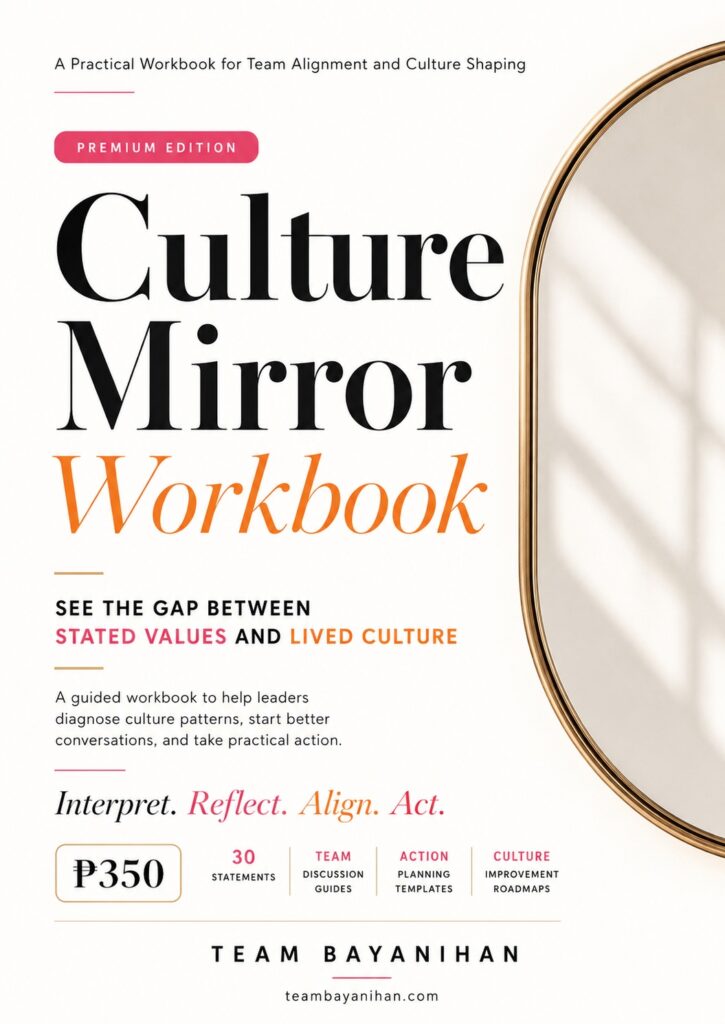
Your values are not your culture. Your daily work is.
Values on the wall do not change behavior.
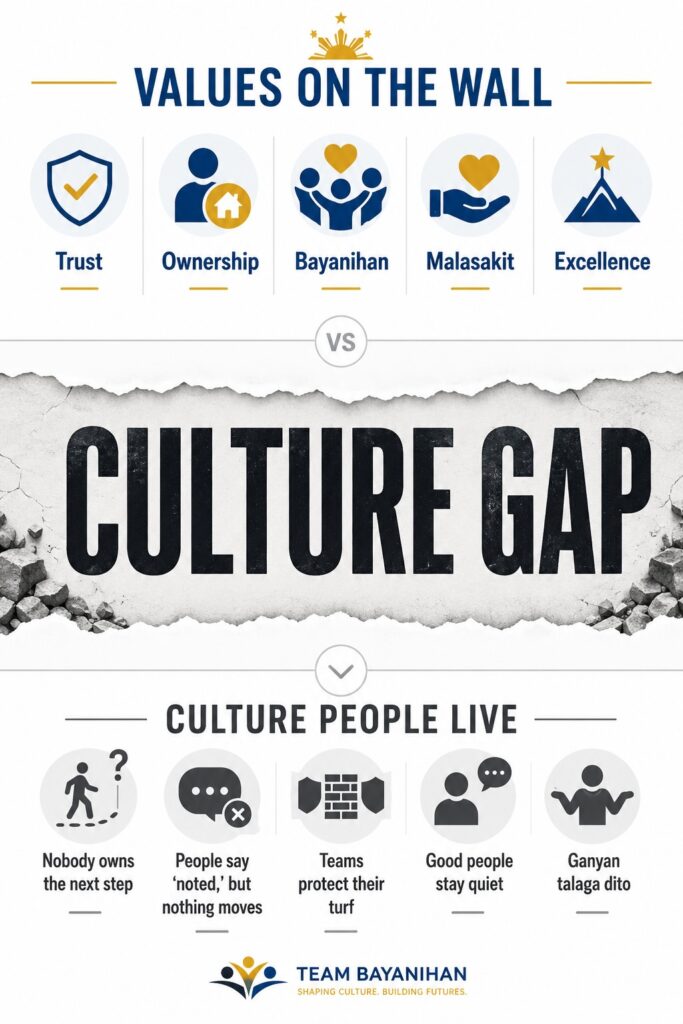
Culture shows up when meetings end with no owner, when people say “noted” but nothing moves, when teams protect their turf, and when good people stay quiet.
Team Bayanihan helps leaders turn stated values into visible behaviors, shared rhythms, and everyday practices rooted in Bayanihan and Filipino values.
Start with your leaders.
Shape the whole team.
Take the Culture Mirror Scorecard
Available in Metro Manila and nearby areas.
Culture Work Must Be Counter-Culture
Every organization has a culture.
The question is not whether you have one. The question is whether the culture you have is helping you win.
Sometimes the culture is written on the wall: trust, excellence, ownership, malasakit.
But the real culture shows up somewhere else.
It shows up when a meeting ends and nobody owns the next step.
It shows up when people say “noted” but nothing moves.
It shows up when teams protect their turf instead of helping the next team succeed.
It shows up when good people stay quiet because speaking up feels unsafe.
That is the culture people live.
And what leaders do not challenge, they allow.
This is why culture shaping must be counter-culture.
It challenges the patterns people have learned to accept: the silos, the silence, the blame, the waiting, the “ganyan talaga dito” way of working.
Because Filipino teams do not lack values.
We know malasakit.
We know bayanihan.
We know pakikipagkapwa.
We know pananagutan.
The problem is not absence.
The problem is design.
These values are not always designed into how people meet, decide, speak, follow through, and serve.
That is the work.
Culture design turns values into behavior.
Counter-culture makes those behaviors stronger than the old habits.
A team says, “We value trust.”
Counter-culture asks, “Where do people still hide the truth?”
A team says, “We value ownership.”
Counter-culture asks, “Where are people still waiting to be told?”
A team says, “We value Bayanihan.”
Counter-culture asks, “Where are we still carrying the work alone?”
The Culture Workshop helps leaders and teams face these questions honestly — and build a better way of working together.
Culture Is Designed, Not Decorated
Culture does not change because leaders announce new values.
It changes when people know what those values look like on a difficult Monday.
Trust is easy to say. But what does trust look like when someone makes a mistake?
Ownership sounds good. But what does ownership look like when a task falls between two departments?
Bayanihan is inspiring. But what does Bayanihan look like when one team is overloaded and another team says, “Hindi sa amin iyan”?
That is where culture design begins.
It takes the values people already believe in and turns them into visible behaviors, shared agreements, and daily rhythms.
Not slogans.
Practices.
In the Culture Workshop, leaders and teams design the culture they want to live.
They name the old patterns that must stop.
They draw the behaviors that must start.
They agree on the moments where culture must show up first.
In meetings.
In handovers.
In decisions.
In conflict.
In service.
In follow-through.
Because culture is not what people remember from a speech.
Culture is what people repeat when the speech is over.
Team Bayanihan helps organizations design that repetition — rooted in Bayanihan, Filipino values, and the real work people do every day.
Culture Must Start with the Executive Team
The Culture Workshop is best experienced by the whole organization. But it must start with the executive team.
Because people do not follow posters. They follow patterns.
If leaders talk about trust but punish bad news, people learn silence.
If leaders talk about ownership but tolerate missed commitments, people learn excuses.
If leaders talk about Bayanihan but allow departments to protect their turf, people learn self-defense.
The real culture is not what leaders announce. It is what leaders allow, model, reward, and repeat.
That is why culture work cannot begin as another HR project. HR can organize the program. But executives must own the pattern.
In the executive session, leaders clarify the culture they want to build, the behaviors they must model first, and the old patterns they must stop tolerating.
They also identify the Filipino values they want to activate, the culture levers that matter most now, and the right way to bring the work to the wider organization.
When leaders are aligned, the whole organization gets a clearer signal:
- This is what we stand for.
- This is what we will practice.
- This is what we will no longer excuse.
Start with the executive team.
Then bring the culture to everyone.
Featured Program: The Culture Workshop
Most organizations already have values.
They are printed on walls, websites, IDs, manuals, and onboarding decks.
But culture is not proven by what is printed.
Culture is proven by what people repeat.
The Culture Workshop is a two-day facilitated culture design experience that helps leaders and teams turn ideal values into visible behaviors, shared rituals, and everyday agreements.
We do not impose a ready-made culture.
We guide your people through a clear process so they can name the culture they want, face the patterns that get in the way, and design how your values will show up in real work.
In meetings.
In decisions.
In handovers.
In conflict.
In service.
In follow-through.
The output is different for every organization because every organization has its own story, values, pressure points, and aspirations.
But the process is clear.
The Best Sequence
First: Executive Team Culture Workshop
Top leaders align on direction, language, and the behaviors they must model first.
Next: Organization-Wide Culture Workshop
Managers, supervisors, and employees understand the culture, own the behaviors, and practice what it looks like in daily work.
Then: Follow-Through Programs
Teams build rhythm, proof, and internal ownership so the workshop does not become another event people forget.
What Happens in Two Days
Day 1: See the Culture Clearly
Participants examine the culture people experience today, name the old patterns that must stop, and identify the values that must become stronger in daily work.
Day 2: Design the Culture in Action
Participants translate those values into visible behaviors, team rituals, culture levers, and follow-through commitments.
The goal is not to leave with beautiful words.
The goal is to leave with a culture people can practice.
Culture Shaping Workshops in Metro Manila
Team Bayanihan facilitates Culture Shaping workshops for organizations in Metro Manila and nearby areas.
We work with executive teams, HR leaders, OD teams, department heads, managers, supervisors, and employees who want to make culture visible in daily work.
Your organization may already have strong values.
But values become culture only when people know how to practice them.
That is where the workshop helps.
We design and facilitate practical culture experiences that help your people align, speak honestly, build shared behaviors, and create team rhythms they can use after the event.
We can run sessions in hotels, conference venues, offices, and offsite workshop spaces across Metro Manila and nearby provinces.
Whether you are preparing for a culture rollout, leadership alignment, team integration, service improvement, or organization-wide transformation, we can help you design the right experience.
The goal is not just to gather people in one room.
The goal is to help them leave with a clearer way of working together.
Start with the Culture Mirror Scorecard
Before you run another culture program, take a quick look at what your people may already be experiencing.
The Culture Mirror Scorecard helps leaders see the gap between stated values and lived culture.
It is a simple starting tool for teams that want to ask better questions before planning a workshop, rollout, or team intervention.
Use it to reflect on:
- how clearly people understand the culture
- how leaders model the values
- how teams communicate and collaborate
- how ownership and follow-through show up
- how much trust, malasakit, and Bayanihan people experience at work
This is not a final diagnosis.
It is a mirror.
It helps you notice what may need attention, what may need strengthening, and what culture conversation your organization must start next.
After you complete the scorecard, you will have a clearer sense of where your culture is strong, where the gaps are, and which Culture Levers may matter most now.