
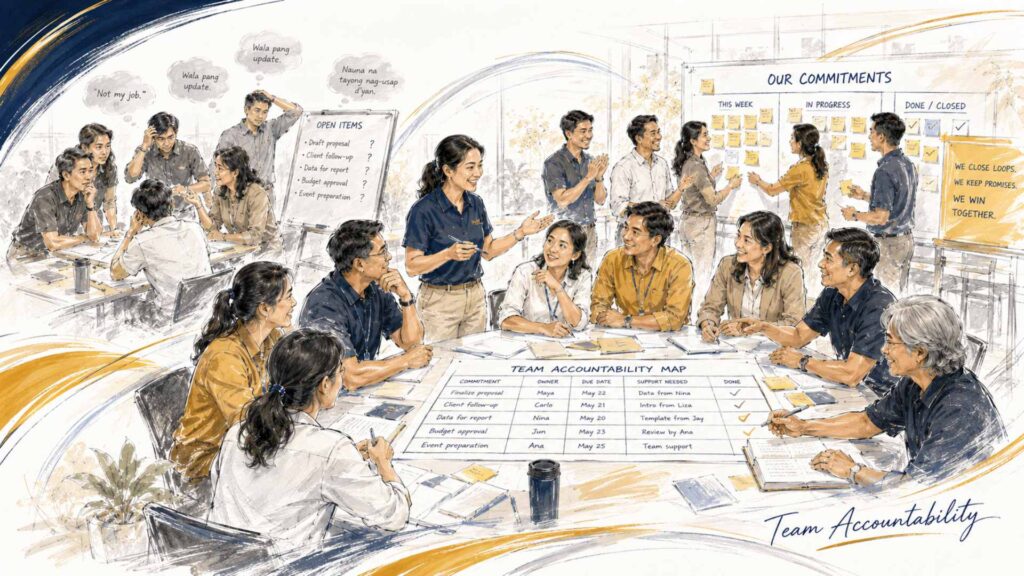
Team Accountability
A team building workshop for teams that need stronger ownership, clearer commitments, and better follow-through.
Some teams know what to do.
That is not the problem.
The problem is what happens after the meeting. Commitments become unclear. Follow-ups depend on the manager. Deadlines move quietly. People wait, explain, excuse, or assume someone else will handle the gap.
Team Accountability helps your people move from reminders and excuses to shared ownership — so the team can keep commitments, close loops, and deliver what they said they would do.
Why Does Work Still Get Delayed When Everyone Knows What To Do?
Some teams do not need another explanation of their job.
They already know the tasks. They know the deadlines. They know the process, the reporting line, and the expected output. In the meeting, everything sounds clear enough.
Then the meeting ends.
That is where accountability begins to break.
A task is assigned, but no one confirms the next move. A deadline is agreed on, but nobody updates when something changes. A teammate sees a delay coming, but waits until the problem is already visible. Someone assumes another person will follow up. Someone says, “Noted,” but nothing actually moves.
The work does not fail loudly.
It slips quietly.
And when this happens often enough, the whole team starts to slow down.
What Happens When the Manager Becomes the Reminder Machine?
In many teams, accountability depends too much on the leader.
The manager checks. The manager follows up. The manager asks for updates. The manager reminds people of what was already agreed on. The manager notices the loose ends, the unclear ownership, the missed handovers, and the tasks that are quietly getting delayed.
At first, this looks like good leadership.
But over time, it becomes exhausting.
The leader becomes the engine of follow-through. People move when asked. They update when reminded. They close loops when the manager starts chasing. The team may still deliver, but the system is weak because ownership is not shared.
A stronger team does not wait for one person to carry the whole weight.
People own their part.
They speak early when there is a problem. They update before being chased. They clarify commitments before confusion spreads. They protect the result because they understand that accountability is not only the manager’s job.
It is the team’s job.
Why Do People Avoid Accountability?
People do not always avoid accountability because they are lazy.
Sometimes, the real issue is fear. If mistakes are punished too quickly, people hide problems. If expectations are unclear, people wait for instructions. If past efforts were ignored, people stop volunteering. If only the leader makes decisions, people learn to stay dependent.
Sometimes, the issue is habit.
People have learned that someone else will remind them. Someone else will fix the gap. Someone else will explain the delay. Someone else will carry the pressure when the work does not move.
That habit becomes expensive.
It creates a team where people are present, but not fully owning the game. They do their assigned tasks, but they do not always protect the shared result. They wait for pressure before they act.
Team Accountability helps the team see this pattern without turning the room into a blame session. The goal is not to shame people. The goal is to help them understand what weak ownership costs everyone.
Where Does Weak Accountability Show Up?
Weak accountability shows up in ordinary workplace moments.
A person agrees to send the update by Friday, but Friday passes with no message. A teammate cannot finish a task, but does not tell anyone early. A handover is incomplete, but the sender says, “Nasend ko na.” A team member joins the meeting, nods, and leaves without really owning a next step.
Then the leader asks, “What happened?”
And the explanations begin.
The client changed something. The other department was late. The file was incomplete. The instruction was unclear. The person was busy. The deadline was misunderstood.
Some reasons may be valid.
But when the same pattern repeats, the team needs more than reasons. It needs a better way to own commitments, raise risks, ask for help, and close loops before work gets damaged.
That is the shift.
From explaining delays to preventing them.
What Does Real Accountability Look Like?
Real accountability is not blame.
Blame asks, “Whose fault is this?”
Accountability asks, “What did we promise, what happened, what must we do now, and how do we prevent this from happening again?”
That difference matters.
A blame culture makes people defensive. They hide mistakes, protect themselves, and wait until they are forced to explain. An accountable team does the opposite. People surface issues earlier because they know the goal is to protect the work, not attack the person.
Real accountability looks like clearer commitments.
It looks like people confirming who owns what, by when, and to what standard. It looks like updates before reminders. It looks like asking for help before the delay becomes a crisis. It looks like teammates caring enough to hold each other to the promise.
Not because they want to police one another.
Because the result matters.
What Shift Are We Trying to Create?
Team Accountability helps people move from compliance to ownership.
Compliance says, “I did what I was told.”
Ownership says, “I understand what we are trying to achieve, I own my part, and I will help protect the result.”
That is a different game.
In a compliant team, people wait for instructions, reminders, and approval. In an accountable team, people clarify, act, update, repair, and follow through. They do not need every move to be pushed by the leader because they understand the shared win.
This workshop helps the team practice the behaviors that make ownership visible: making clear commitments, closing loops, raising risks early, asking for help, and taking responsibility for the next move.
The goal is not to make people feel guilty.
The goal is to make ownership easier to practice.
What Does Winning Look Like After Team Accountability?
Winning looks like fewer reminders.
It looks like people who update before being chased. It looks like meetings that end with clear owners, clear actions, and clear next steps. It looks like teammates who raise problems early instead of hiding delays until the last minute.
The leader feels the difference too.
There is less chasing, less guessing, and less emotional weight. The manager no longer has to be the only person protecting the work because more people are taking responsibility for the promises the team made.
That is what Team Accountability is designed to create.
Not fear.
Not blame.
A team that owns the work, protects the standard, and follows through together.
Ask About Team Accountability
You do not need to have everything final before you inquire.
Your date, venue, number of participants, and exact goals may still change. That is okay.
Tell us what you already know about your team and what you want to improve. If commitments are unclear, follow-through depends too much on the manager, deadlines keep slipping, or people wait to be reminded before they act, Team Accountability may be the right workshop to explore.
We will help you see if this fits your team’s situation.
Frequently Asked Questions About Team Accountability
Who is Team Accountability best for?
Team Accountability is best for teams that need stronger ownership, clearer commitments, and better follow-through.
It is a good fit when managers keep reminding people, deadlines slip quietly, commitments disappear after meetings, or team members wait for instructions instead of owning the next move.
What workplace issues can Team Accountability help address?
Team Accountability can help address unclear ownership, weak follow-through, repeated delays, missed commitments, slow updates, poor handovers, and too much dependence on the manager.
It is especially useful when people know what to do, but the work still does not move unless someone keeps checking.
Is this workshop about blaming people?
No. Team Accountability is not about blame.
Blame asks, “Whose fault is this?” Accountability asks, “What did we promise, what happened, what must we do now, and how do we prevent this from happening again?”
The goal is to help people own the work without creating fear.
What does accountability look like at work?
Accountability at work looks like clear commitments, timely updates, early risk-raising, honest follow-through, and people closing loops before they are chased.
It also means caring enough about the team result to ask for help, clarify expectations, and take responsibility for the next move.
What happens during Team Accountability?
Participants go through facilitated activities, reflection, and team conversations that make ownership and follow-through visible.
The workshop helps the team see what happens when people assume, wait, avoid, delay, or step up. Then participants connect those patterns to real workplace situations.
Can Team Accountability be customized?
Yes. We can customize Team Accountability based on your team size, schedule, venue, goals, and current workplace situation.
Some teams need clearer commitments. Some need stronger follow-through. Some need to reduce dependence on the manager. Some need to rebuild ownership after repeated delays. We shape the workshop around what your team needs most.
Can this be done indoors or outdoors?
Yes. Team Accountability can be facilitated indoors, outdoors, or in a mixed format.
Indoor formats work well for reflection, conversations, and team agreements. Outdoor or activity-based formats work well when the team needs movement, energy, and shared experience before connecting the lessons to work.
How long is the workshop?
Team Accountability can be designed as a half-day, one-day, or custom-format workshop.
A half-day works well for one focused accountability shift. A one-day workshop gives more room for activities, reflection, and practical team commitments. A custom format may be better for larger groups or teams with deeper ownership issues.
What will participants bring back to work?
Participants should bring back clearer language and practical behaviors for ownership.
They should leave with a better way to make commitments, confirm next steps, raise risks early, ask for help, close loops, and protect the shared result.
How do we know if Team Accountability is right for us?
Team Accountability may be right for your team if people are working hard, but ownership is still unclear.
If your managers are tired of chasing, reminding, and carrying the pressure alone, this workshop is worth exploring.
About Team Bayanihan
Team Accountability is facilitated by Team Bayanihan, a trusted team building facilitation company that designs purposeful team building experiences for Filipino organizations.
Our work helps teams move beyond fun and games, so people can practice trust, collaboration, accountability, malasakit, and shared wins at work.
Learn more about Team Bayanihan.