
Team building in the Philippines for teams tired of the same old routine.
You know how it goes.
Book a venue.
Prepare the food.
Play the games.
Shout “One Team!”
Take the photo.
Go home tired.
Then Monday comes.
The silos are still there. The meetings still end with “noted.” The follow-ups still disappear. The same people still wait for someone else to move.
That is the old team-building routine.
Team Bayanihan designs and facilitates team building in the Philippines for organizations that want the day to change how people work.
Not just more activities to play.
Not just another host with a microphone.
Not just another group photo with matching shirts.
We help your people see the real game they play at work: how they trust, decide, speak up, take ownership, and follow through.
Then we help them practice a proven way to win together.
Through purposeful play, guided reflection, and Filipino values, your team learns how to work as one—long after the event is over.
Ask About a Team Building Workshop
Start a Different Kind of Team Building
The problem is not your team building day.
It is the Monday after.
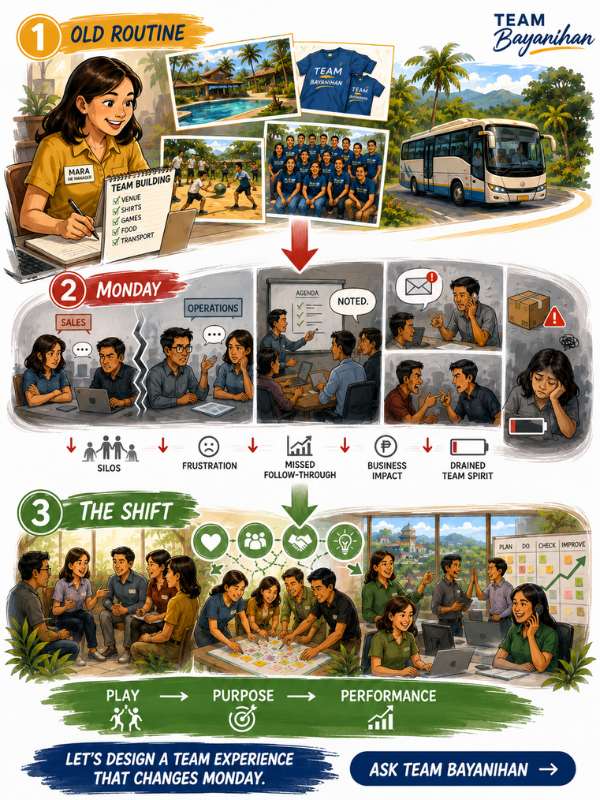
Mara is the HR manager of a growing company in Laguna.
Last year, she did everything right. She booked a resort. She arranged the food. She ordered the shirts. She hired a host. She watched people laugh, cheer, and shout “One team!” until their voices were almost gone.
On the bus home, everyone looked happy.
For one day, the team felt alive.
Then Monday came.
The Sales team still blamed Operations for delays. Operations still said Sales kept overpromising. Supervisors still waited for instructions before making decisions. Meetings still ended with “noted,” but no one owned the next move.
By Wednesday, the old walls were back.
Mara felt it first in the group chats. Short replies. Safe answers. No one wanted to sound difficult. No one wanted to be the first to say, “This is not working.”
Then she felt it in the business.
A client update was missed. A delivery issue became a blame thread. A small mistake traveled through three departments before anyone said, “Ako na.”
The team did not lose energy because they were lazy.
They lost energy because the team building gave them a good day, but not a new way to work.
That is the old team-building routine.
It gives people activities to play, but not behaviors to practice. It creates laughter, but not language. It gives the team a photo, but not a shared way to trust, decide, speak up, take ownership, and follow through.
Fun is not the enemy.
Fun opens the door.
But if the experience does not help people see how they really work together, decide what must change, and practice a better way to move, Monday will always win.
Team Bayanihan starts there.
Not with the list of games.
With the shift your team needs when they go back to work.
Most team building packages solve the logistics.
Venue. Food. Transportation. Shirts. Hosts. Prizes. Games.
That is why many team building providers in the Philippines offer packages. Some are event organizers. Some are resorts or venues. Some help you plan the outing, move the people, feed the group, and run the program.
There is nothing wrong with that.
If what you need is an event, a package can help.
But if what you need is a team that works better after the event, logistics will not be enough.
A resort can give your people a place to gather. A host can give them energy. A game can make them laugh.
But who will help them see why Sales and Operations keep blaming each other? Who will help quiet people speak up? Who will help managers turn “noted” into ownership? Who will help the team practice follow-through before they return to work?
That is a different job.
And that is where Team Bayanihan begins.
Team building is not a break from work.
That is where many programs get stuck.
People arrive thinking, “Please, no work talk today.” They want to relax. They want to laugh with friends. They want good food, a good venue, and a day without deadlines, clients, reports, and managers asking for updates.
Fair.
People need rest. Teams need space to breathe. A good team building day should give people joy, energy, and connection.
But if the whole day is only an escape from work, the team returns with the same problems it left behind.
The same silos. The same quiet meetings. The same blame. The same missed follow-through. The same people waiting for someone else to move.
That is why Team Bayanihan treats team building differently.
We do not drag people into another office meeting with games on the side. We do not turn the day into a lecture about performance. And we do not kill the fun by forcing people to “process” every five minutes.
We use play to lower the walls.
Then we use reflection to reveal what those walls are.
Because the best team building does not make people run away from work. It helps them see work differently.
It shows them how they listen when pressure rises. How they decide when the rules are unclear. How they speak up when the room is quiet. How they support a teammate before the task explodes. How they follow through when nobody is clapping.
That is the real practice.
Not forced seriousness.
Not fake fun.
Purposeful play.
A team can laugh and still learn. They can relax and still reflect. They can enjoy the day and still leave with a better way to work together.
That is the kind of team building Team Bayanihan designs.
Not a break from work.
A better return to work.
What Team Bayanihan does differently
Most team building in the Philippines starts with the visible parts:
Venue. Food. Transportation. Games. Shirts. Prizes. Host. Sound system. Group photo.
Those things matter.
Someone has to plan them. Someone has to make sure people arrive, eat, move, laugh, and get home safely. But those things do not build the team. They support the event.
Team Bayanihan starts with the part most programs miss: The work your people must return to.
Because the real question is not: “What activity will make people laugh?”
The real question is: “What behavior must change when they are back in the office?”
That is where we begin. We design and facilitate team building in the Philippines for organizations that want more than a good day. We help teams practice the behaviors that make work better:
Trust. Ownership. Communication. Collaboration. Initiative. Follow-through.
So before we choose an activity, we look for the shift.
If people blame each other when something goes wrong, we design for ownership.
If meetings end with “noted” but no movement, we design for follow-through.
If departments protect their own corners, we design for shared responsibility.
If quiet people stay quiet even when they see the problem, we design for courage and voice.
Once the shift is clear, the whole experience becomes sharper.
The game is not random. It reveals the pattern.
The debrief is not filler. It names the lesson.
The reflection is not drama. It helps people see what they usually avoid.
The commitment is not a slogan. It becomes one behavior they can practice on Monday.
People still laugh. They still move. They still enjoy the day.
But now the fun has a job. It lowers the walls. It opens the room. It makes the truth easier to see.
That is the Team Bayanihan difference.
We turn team building from an event people attend into a practice teams can repeat.
Not just “masaya.”
Useful.
Not just “one team” in the photo.
One team in the way people work.
The Team Bayanihan Way
We don’t begin with games.
We begin with the win.
Because teamwork is not the goal by itself. Teamwork must help the organization win at something that matters.
Faster coordination. Better service. Stronger trust. Clearer decisions. More ownership. Real follow-through.
That is why the Team Bayanihan Way is simple:
Strategy first. Culture next. Practice through experience.
First, we clarify what the team must win at.
Then, we name the culture that will make that win possible.
Then, we design a team experience where people practice the behaviors that culture requires.
So team building becomes more than activities.
It becomes a practice field.
People practice speaking up. Listening better. Helping across teams. Owning the next move. Following through after the meeting ends.
That is why our team building in the Philippines feels different.
Fun, but not random.
Filipino, but not decorative.
Reflective, but not heavy.
Practical, because every activity points back to work.
The goal is not only for people to say, “Masaya.”
The goal is for them to say:
“Now we know how to win together.”