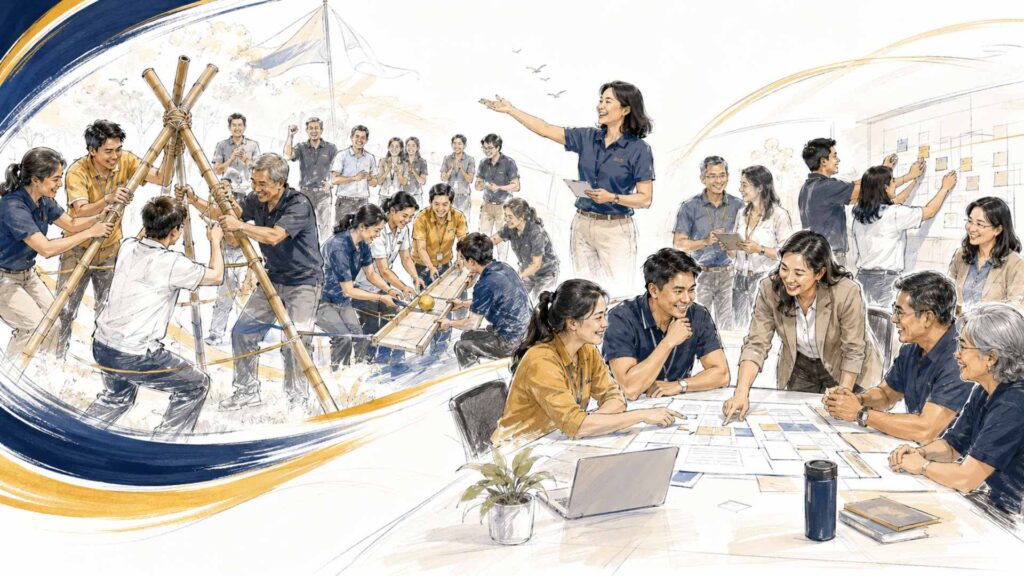
Bayanihan Team Challenge
A flexible team building experience that turns games into practice for better teamwork at work.
We design each Bayanihan Team Challenge around your team’s real needs — trust, communication, collaboration, alignment, accountability, malasakit, or follow-through.
Your people will play, solve, reflect, and discover better ways to work together.
Half-day, whole-day, or two-day formats are available.
What Is Really Getting in the Way?
Most teams do not fail because people do not know the word teamwork.
They fail in ordinary moments.
A handover is unclear, so the next person guesses. A meeting ends with everyone nodding, but no one really owns the next step. Someone sees a problem early but stays quiet because speaking up might create tension.
At first, leaders do not always call these teamwork problems. They call them delays, miscommunication, lack of initiative, poor coordination, attitude, or silo mentality.
But underneath those labels is a deeper pattern.
People are not working together in a way that helps the team win.
That is what Bayanihan Team Challenge helps reveal. It gives the team a shared experience where their usual patterns become visible without turning the room into a blame session. People get to see how they communicate, decide, support, hesitate, rush, recover, and follow through when the pressure is real but the stakes are safe.
Why Do Busy Teams Still Feel Stuck?
Some teams look busy every day, but still feel stuck.
Everyone has tasks. Everyone has deadlines. Everyone has messages to answer. But when you ask, “What are we really trying to win together?” the answers are not always the same.
One person thinks the priority is speed. Another thinks it is quality. Another thinks it is avoiding mistakes. Another is simply trying not to be blamed.
So the team works hard.
But not always in the same direction.
That kind of work is exhausting. People can spend the whole week attending meetings, sending updates, following up, and fixing issues, yet still feel that nothing important is moving forward.
The problem is not effort.
The problem is scattered effort.
In the Bayanihan Team Challenge, we help people feel the difference between working hard and working together. When the team sees what slows them down inside the challenge, they can begin to ask better questions about what slows them down at work.
What Happens When Trust Is Low?
When trust is low, people become careful.
They soften feedback. They hide mistakes. They wait for the boss to decide. They avoid asking for help because they do not want to look weak. They avoid challenging ideas because they do not want to offend.
From the outside, the team may still look peaceful. People smile. They cooperate. They say the right things.
But polite is not always honest.
And silence is not always agreement.
Over time, small issues become repeated issues because no one names them early. The same confusion returns. The same tensions stay hidden. The same people carry the same weight while others stay on the side.
A good team challenge gives the group a safer way to see these patterns. Instead of saying, “You always do this at work,” people can say, “Did you notice what happened during the activity?”
That small distance matters.
It makes the truth easier to discuss.
What Happens When Ownership Is Weak?
In some teams, people know what needs to be done, but the work still gets delayed.
Someone assumes another person will follow up. Someone waits for clearer instructions. Someone notices the gap but does not step in. Someone quietly says, “Hindi sa akin yan.”
Then the manager becomes the reminder machine.
The leader follows up, checks, repeats, reminds, and carries the weight that should have been shared by the team.
It may work for a while.
But it is not sustainable.
Weak ownership does not always come from laziness. Sometimes it comes from unclear expectations, fear of making mistakes, lack of confidence, or a habit of waiting for authority. But whatever the cause, the result is the same: the team moves only when someone pushes.
Bayanihan Team Challenge helps people experience what shared ownership feels like. In a challenge, the team quickly sees what happens when people wait, avoid, assume, or step up.
The lesson becomes easier to remember because they experienced it together.
What Happens When Communication Breaks Down?
Communication problems are not always loud.
Sometimes they look harmless.
A message was sent, but not understood. A deadline was mentioned, but not confirmed. A decision was made, but not repeated clearly. A task was assigned, but the standard was not explained.
Then people get surprised later.
“Akala ko tapos na.”
“Hindi ko alam na urgent pala.”
“Bakit ngayon lang sinabi?”
These moments sound simple, but they cost time, energy, trust, and sometimes money.
The problem is not only that people failed to communicate. The deeper problem is that the team does not have enough shared habits for clarity.
People need better ways to ask, confirm, clarify, hand over, and close the loop.
Inside the challenge, communication becomes visible. People see who speaks first, who listens, who assumes, who clarifies, who checks, and who keeps moving without making sure others are with them.
Once the team sees the pattern, they can practice a better one.
Why Use Games and Activities?
We use games and activities because they help people experience teamwork before they explain it.
A short challenge can reveal more about a team than a long lecture. Under pressure, people show how they think, decide, support, compete, avoid, lead, follow, and recover.
But the game is not the point.
The game is the mirror.
It gives the team something real to talk about without making the conversation personal too soon.
After the activity, we pause and help people notice what happened. What helped the team move? What slowed the team down? Who stepped up? Who stayed silent? What did people assume? What did the team need but failed to ask for?
That is where the activity becomes useful.
The team begins to connect the experience to meetings, projects, handovers, customer issues, leadership habits, and daily collaboration. They stop talking about teamwork as an idea and start seeing it as behavior.
What Shift Are We Trying to Create?
The goal is not simply to make people happier for a day.
Energy matters.
Laughter matters.
Shared joy matters.
But energy alone is not enough. A team can laugh together during the event and still return to the same broken patterns on Monday.
The real goal is to help the team practice a better way of working together.
From silence to honest conversation. From guessing to clarity. From waiting to ownership. From blaming to helping. From “my task” to “our win.”
That is why Bayanihan Team Challenge is flexible. The activities may change. The format may change. The focus may change.
But the purpose stays clear.
Help the team see where they are, understand what keeps them stuck, and practice one better way to win together.
When people experience the shift together, the language becomes shared. They can point back to the challenge and say, “This is what happened there, and this is also what happens at work.”
That is when the lesson begins to stick.
What Does Winning Look Like After the Workshop?
Winning is not only the team that finishes first.
It is not the loudest cheer, the best photo, or the trophy at the end of the day. Those moments are good, but they are not the real measure.
The better win is when people return to work with a shared reference point.
They can say, “This is where we got stuck.”
They can say, “This is what helped us move.”
They can say, “This is what we need to practice next.”
That kind of win shows up in daily work. A team communicates sooner. People ask for help faster. Commitments become clearer. Teammates support instead of watch. Leaders stop carrying everything alone because more people understand the game they are playing together.
That is what Bayanihan Team Challenge is designed to create.
Energy in the room.
Connection among people.
Shared wins they can bring back to work.
Frequently Asked Questions About Bayanihan Team Challenge
Who is Bayanihan Team Challenge best for?
Bayanihan Team Challenge is best for teams that need energy, connection, movement, and shared wins.
It is a good fit when people have been working hard but not always working together, when the team needs to reconnect, or when leaders want a team building experience that is fun in the room but still useful back at work.
What workplace issues can Bayanihan Team Challenge help address?
Bayanihan Team Challenge can help address weak collaboration, unclear communication, low energy, silo mentality, lack of ownership, slow support, and poor follow-through.
The focus depends on what your team needs most. Some teams need to rebuild connection. Some need to practice better coordination. Some need to strengthen trust, accountability, or malasakit.
Is this only about games and activities?
No. Games and activities are part of the experience, but they are not the point.
We use activities to help the team see how they communicate, decide, support, lead, follow, and respond when things get challenging. The real value comes from the reflection, debrief, and workplace connection after the activity.
What makes Bayanihan Team Challenge different from ordinary team building?
Ordinary team building often stops at fun, photos, and prizes.
Bayanihan Team Challenge goes further. The experience is designed to help participants see real teamwork patterns, talk about what happened, and connect the lessons to how they work together every day.
Can the program be customized?
Yes. Bayanihan Team Challenge is designed around your team’s situation.
We can adjust the activities, flow, reflection questions, and focus based on your goals, team size, venue, schedule, and workplace challenges.
What can the challenge focus on?
The challenge can focus on trust, communication, collaboration, alignment, accountability, malasakit, leadership, problem-solving, or follow-through.
We do not recommend choosing a theme only because it sounds good. We begin by understanding what your team needs to practice now.
Can this work for large groups?
Yes. Bayanihan Team Challenge can work for small teams, departments, and large groups.
For larger groups, we design activities that are easy to understand, high-energy, safe to facilitate, and meaningful for many participants at the same time.
Can this be done indoors or outdoors?
Yes. Bayanihan Team Challenge can be facilitated indoors, outdoors, or in a mixed format.
Indoor formats work well for reflection, alignment, and guided conversations. Outdoor formats work well for movement, energy, team games, and large-group participation. We can help you decide which format fits your team and venue.
How long is the workshop?
Bayanihan Team Challenge can be designed as a half-day, one-day, or two-day experience.
A half-day works well for one focused team shift. A one-day workshop gives more space for activities, reflection, and team commitments. A two-day format works best when the team needs deeper work on trust, alignment, leadership participation, or more complex workplace issues.
What will participants bring back to work?
Participants should bring back more than a good memory.
They should leave with a shared experience, clearer language for what helps or hurts their teamwork, and one or two practical commitments they can use when they return to work.
How do we know if Bayanihan Team Challenge is right for us?
Bayanihan Team Challenge may be right for your team if you want a flexible, high-energy team building experience that can be shaped around your team’s real needs.
If your team needs to reconnect, move together, communicate better, build trust, or create shared wins, this workshop is worth exploring.
About Team Bayanihan
Bayanihan Team Challenge is facilitated by Team Bayanihan, a trusted team building facilitation company that designs purposeful team building experiences for Filipino organizations.
Our work helps teams move beyond fun and games, so people can practice trust, collaboration, accountability, malasakit, and shared wins at work.
Learn more about Team Bayanihan.