
You have decided to bring your team to El Nido. Now the questions begin. Where will you stay? Who can facilitate the team building? What will everyone actually do for three days and two nights? You search for resorts, look at island tours, perhaps ask HR to find a facilitator—and somewhere along the way you begin building a familiar program: meeting room, activities, lunch, more activities, closing.
And that would be such a waste.
You flew people to El Nido. Outside that meeting room are boats leaving for islands, beaches hidden between limestone walls, unfamiliar roads, meals that can stretch into conversations, and hours when your executives can finally be with one another without somebody saying, “I have another call.” Yet it is surprisingly easy to bring people all that way and recreate the office inside a resort.
I know because I have done it.
Clients have brought me to El Nido to train their people, and I trained them indoors. The training had value. People learned. We accomplished what we came there to do. But when I think about those visits now, I see something I did not see clearly enough then: El Nido could have been part of the learning.
That changes how I would design your team building today.
If you bring me from Los Baños to work with your team in El Nido for three days and two nights, I do not need your people for six hours every day. I would rather have one good hour on the first day, perhaps two concentrated hours outdoors on the second, and another hour before everyone leaves. Four facilitated hours may be enough.
Because I am not interested in occupying their time.
I want to change how they experience it.
On the first afternoon, after people have checked in and recovered from the trip, we gather outside if the place allows it. No long presentation. No attempt to manufacture energy from people who have just traveled. I give them one mission for the days ahead: enjoy El Nido, and pay attention to how we move together.
At first, that sounds almost too simple.
Then the trip starts producing evidence.
Someone has already boarded while another person is still looking for a bag. One executive quietly helps a colleague who is unsure getting onto the boat. Somebody always knows where everyone should be; somebody else assumes someone will tell him. Plans shift and one person becomes irritated. Lunch arrives and, without being asked, someone begins making sure everybody has what they need.
Nobody arranged these moments.
That is why I want them.
A conventional team-building game creates a situation so we can observe teamwork. El Nido gives us situations all day long. My role is to help people notice what those moments reveal without turning their holiday into a nonstop seminar.
So we travel.
We take the boat. We go to the islands. People swim if they want to swim. They take photographs. They eat. They talk. They rest.
And somewhere in that day, I introduce one or two deliberate outdoor challenges.
I might give small groups something they have to accomplish with limited resources. I might design a challenge in which several groups can succeed only when their separate work eventually fits together. Or I may create a handoff in which finishing your own part means very little if the next person cannot continue from what you gave them.
I do not need twelve games.
I need a few revealing moments.
Because later, when we sit together—perhaps after people have showered, changed clothes, and had time to breathe—I can ask a question that a conference room rarely answers well:
What did you notice about us today?
Now nobody has to imagine a case study.
They were there.
Someone can say, “We were so focused on getting there that we didn’t notice two people were falling behind.”
Another might laugh and say, “The moment something went wrong, we all looked at the same person.”
Someone else may remember, “Actually, when we stopped trying to solve it separately, everything became easier.”
Now I have something worth facilitating.
We can talk about what happens back in Singapore when one function moves faster than everyone else. We can examine how a regional team in Malaysia, India, and the Philippines makes decisions when nobody clearly owns the next move. We can ask whether senior leaders genuinely help one another succeed—or whether each executive is simply very good at running his or her own part of the business.
El Nido gave us the experience.
We give it meaning.
And on the final morning, I would resist another common temptation: trying to summarize everything people supposedly learned. Adults do not need me to tell them what their own experience meant.
I would ask them to decide what deserves to travel home.
What happened here that we want more of?
What did we see about ourselves that we cannot unsee?
And when the pressure returns, the calendars fill again, and nobody has an island in front of them, what will we actually do differently?
The answer may be surprisingly small. Raise the concern sooner. Check who is being left behind. Make the handoff useful to the next person. Ask for help before the problem becomes expensive.
Small moves. But now they have a story attached to them.
Months later, someone in an executive meeting may say, “We’re doing that El Nido thing again.”
And everyone in the room will know exactly what she means.
That is what I want from destination team building. Not three days filled with activities. Not training transported from a Manila conference room to Palawan.
I want the place, the people, and the ordinary surprises of traveling together to expose something worth seeing.
Then we build from there.
Planning your next team building?
Don’t start with games.
Don’t start with the venue.
Don’t start with the package.
Start with the shift.
What does your team need to see, practice, and carry back to work after the event?
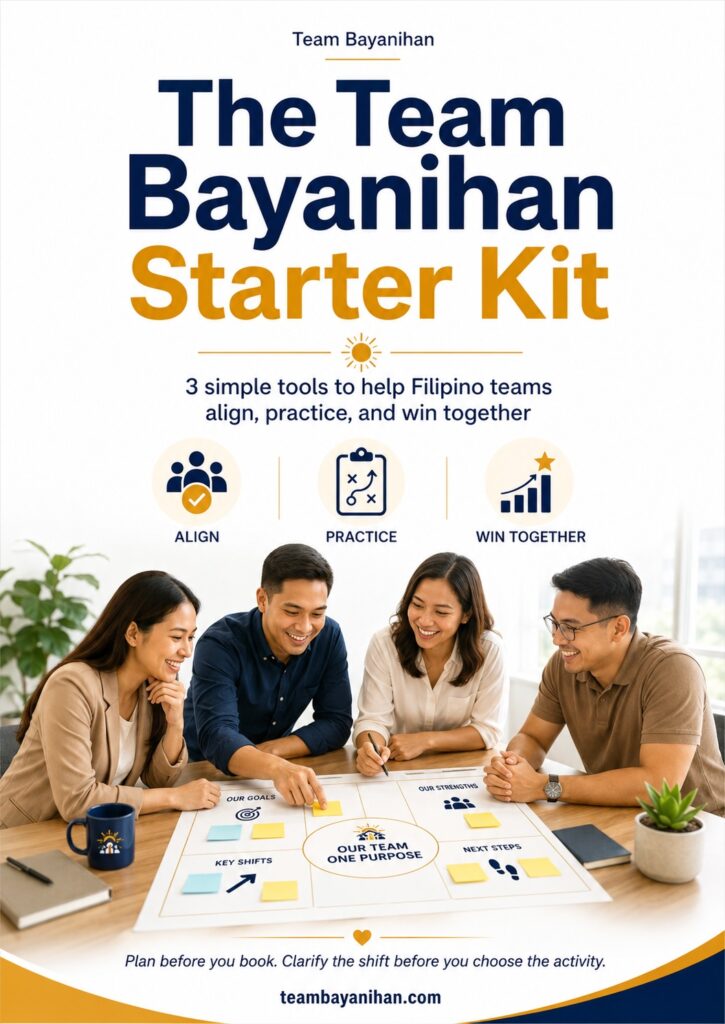
That is why Team Bayanihan created the Bayanihan Starter Kit.
It helps leaders, HR teams, and organizers think clearly before they plan. Inside, you’ll find simple tools to help you identify what your team really needs, avoid the usual team-building mistakes, and design an experience that leads to action.
Because team building should not end with photos. It should show up on Monday.
Team Building in El Nido: What If the Experience Itself Builds the Team?
200 Team Names for Workplace Team Building

40 Inspiring Team Building Quotes for Work

200 Best Hardwork Pays Off Quotes