
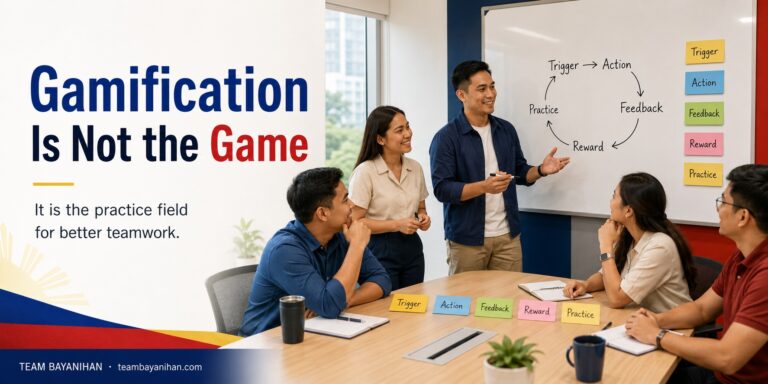
A lot of managers and facilitators miss the real power of gamification.
They hear the word and think of games. Points. Badges. Prizes. Leaderboards. Winners. Losers. People shouting in team colors.
That version is easy to see. It is also easy to sell. Put people in groups, give them a challenge, count the scores, reward the winners, and you now have a “gamified” team-building workshop.
But something is missing.
Because the real power of gamification is not what happens while people are playing. The real power shows up later, when the team returns to work and faces the same pressure that used to bring out the same old behavior.
That is where we find out if anything changed.
The workshop is not the whole team building
Many people think team building is the one-day event. The resort. The hotel ballroom. The outdoor games. The facilitator with a microphone. The group photo at the end.
That is only one part of team building.
Team building is bigger than the workshop. The one-day program may create a shared experience, but the team is built in the preparation, the design, the debrief, and the follow-through. It starts when leaders name the real behavior they want to strengthen. It continues when the activity is designed around that behavior. It becomes useful when the debrief helps people connect the activity to work. And it becomes real when the team brings one lesson into Monday huddles, project meetings, handovers, customer conversations, and pressure moments where old habits usually return.
That last part matters.
Because most teams do not break down when everyone is relaxed. They break down when there is pressure. A deadline is slipping. A customer is angry. A handover is unclear. A decision must be made fast. A teammate drops the ball. A department says, “Hindi sa amin ‘yan.”
That is where team building is tested.
Not in the game.
At work.
Gamification is not just games
Gamification does not mean turning everything into a game. It means using game elements to help people practice a behavior.
That distinction is important.
A game is an activity. Gamification is a design choice. You can use gamification inside a role play, a debrief, a meeting, a weekly challenge, a team habit, or a follow-through system after the workshop. The goal is not to entertain people. The goal is to make the desired behavior easier to notice, easier to practice, and easier to repeat.
A game may ask, “Who wins?”
Gamification asks, “What behavior are we trying to build?”
That is why points and prizes are not enough. They may create excitement, but they do not automatically create learning. People can win the game and still miss the lesson. They can enjoy the activity and still return to the same habits.
The better question is this: What should people start doing differently when the same situation happens again?
Want your team building to create real change after the games end?
Learning is not the explanation. Learning is the changed behavior.
A participant can explain teamwork and still avoid helping a teammate.
A manager can say, “We need accountability,” and still end a meeting without clear owners.
A team can attend a trust-building activity and still withhold information from another department the next week.
That is why insight is not enough. People often understand the lesson but fail to practice it when the old situation returns. The trigger is familiar, so the old behavior comes back quickly.
Gamification helps because it changes the situation.
In normal work, a late deadline may trigger silence, blame, or excuses. But if the team agrees to use a “red flag” rule, the same situation now invites a different behavior: raise the risk early, ask for help, and protect the result before it breaks. The game element is not the point. The point is that the trigger changed. The team now has a visible action, immediate feedback, and a small reward for practicing the behavior they used to avoid.
This is how participants become practitioners.
They are no longer just people who attended a workshop. They are people practicing a new way of working in the moments that matter.
The old pattern must be interrupted
Every team has patterns.
Some patterns are helpful. People check on each other. They clarify before acting. They raise concerns early. They own commitments.
Other patterns quietly weaken the team. People stay silent in meetings. They agree without understanding. They wait for the boss to decide everything. They finish their part but ignore the result. They help only when asked.
These patterns do not always look dramatic. Often, they look normal.
That is the danger.
A team may say, “Ganito talaga dito.” And once a team accepts a weak pattern as normal, the pattern becomes culture.
Gamification interrupts the pattern by adding a new variable. For example, instead of ending every meeting with vague agreement, the team can use a “clear commitment check.” Before the meeting ends, every commitment must have three things: owner, deadline, and next action. The team gets immediate feedback because unclear promises are exposed right away. Over time, the practice teaches people that agreement is not enough. Clarity is part of accountability.
That is a small thing.
But small things repeated under the right conditions change how a team works.
Use gamification before, during, and after the workshop
If gamification is only used during the workshop, its effect may be short-lived. The experience becomes memorable, but not always transferable. People remember the game, but not the practice.
The better approach is to design the whole team-building journey.
Before the workshop, gamification can prepare people to notice their current behavior. For example, one week before the session, you can ask participants to complete a simple “Bayanihan at Work Challenge.” Each day, they look for one behavior: someone helping before being asked, someone clarifying a task, someone owning a missed commitment, someone sharing resources. This kind of pre-work does not feel heavy, but it primes people to see teamwork as behavior, not just a theme.
During the workshop, gamification helps people experience team dynamics in a safe and memorable way. A challenge may reveal how people communicate under time pressure. A role play may show how leaders give unclear instructions. A simulation may expose how quickly people blame when resources are limited. But the facilitator must connect the dots. The activity is only the mirror. The debrief turns that mirror into learning.
After the workshop, gamification becomes a practice system. This is where many programs stop too soon. A team may leave with good intentions, but without a trigger, a visible action, and feedback, people usually return to what they know. A 30-day challenge, a weekly scoreboard, a peer recognition ritual, or a short huddle practice can keep the behavior alive long enough for people to repeat it in real work.
That is where the shift becomes practical.
A simple example: the handover problem
Let’s say a team has a recurring handover problem.
Work moves from one person to another, but details get lost. The next person receives the task but not the context. The customer follows up, and the new owner says, “Hindi ko alam. Kakapasa lang sa akin.” Nobody wants to fail, but the system makes failure easy.
In the workshop, you can design a simple activity where teams must pass instructions through several people before completing a task. The first round will likely expose the old pattern. Someone assumes too much. Someone passes incomplete information. Someone focuses only on finishing their part. The result suffers.
The debrief should not stop with, “Communication is important.” That is too obvious. Ask sharper questions.
What information got lost?
What did the receiver need but did not get?
What did the sender assume?
Where does this happen at work?
What should a good handover always include?
From there, the team can agree on a simple practice: every handover must include status, gap, and next action.
Then gamification continues after the workshop. For the next 30 days, the team runs a “Clear Handover Challenge.” Every time someone gives a complete handover using the three parts, the receiver marks it. During Friday huddle, the team reviews what improved and where breakdowns still happen.
Notice what changed. The team did not merely learn about handovers. They practiced better handovers in real situations.
That is team building.
The practice loop
A useful way to design gamification is to think in a simple loop.
| Element | Design Question |
|---|---|
| Trigger | What situation should remind people to practice the behavior? |
| Action | What specific behavior should they do? |
| Feedback | How will they know they did it right? |
| Reward | What makes the behavior worth repeating? |
| Investment | How will they become more committed to the practice? |
This is not complicated, but it requires intention.
Take the “red flag” example. The trigger is a deadline at risk. The action is to raise the concern early. The feedback comes when the team responds with help instead of blame. The reward is not a prize; it is relief, trust, and progress. The investment grows when people experience that early honesty protects the team.
The team learns a new response to an old situation.
That is the real work.
Where Bayanihan enters
For Team Bayanihan, gamification must serve something deeper than engagement.
It must build Bayanihan at work.
That means we do not use game elements only to create winners. We use them to help people practice the values and behaviors that make Filipino teams stronger: malasakit, pananagutan, maasahan, pakikipagkapwa, trust, collaboration, and follow-through.
This also means we must be careful about what we reward.
If a challenge rewards only speed, people may cut corners.
If it rewards only individual victory, people may ignore the team.
If it rewards only loud participation, quiet contribution may disappear.
Good gamification rewards the behavior you want to see again. If you want malasakit, reward helping before being asked. If you want pananagutan, reward people who protect the result, not just their assigned task. If you want collaboration, reward teams that share resources and bring others along.
The design teaches the team what matters.
What managers and facilitators should ask first
The usual question is, “What game should we use?”
That is not a bad question, but it should not be the first one.
Start here:
| Better Question | Why It Matters |
| What workplace situation do we want to improve? | This keeps the design tied to real work. |
| What old behavior shows up in that situation? | This names the pattern you want to interrupt. |
| What new behavior should people practice? | This gives the experience a clear target. |
| What game element can support that behavior? | This keeps gamification purposeful. |
| How will practice continue after the workshop? | This turns the event into a behavior system. |
When you answer these questions, you stop looking for random games. You begin designing a practice field.
And that is the point.
The real power of gamification
The real power of gamification is not that people enjoy the activity.
Enjoyment helps, but it is not the finish line.
The real power is that gamification can help people practice a new behavior in the situation where the old behavior usually appears. It gives the team a trigger, a specific action, feedback, and a reason to repeat the behavior. Done well, it turns theory into application.
This is why gamification belongs before, during, and after the team-building workshop. Before the workshop, it prepares attention. During the workshop, it makes behavior visible. After the workshop, it helps the team practice the behavior until it becomes part of how they work.
That is how participants become practitioners.
And that is how team building becomes more than an event.
Your next move
Before choosing an activity for your next team-building workshop, pick one behavior your team needs to practice.
Make it specific.
Not “better teamwork.”
Say, “Raise risks early.”
Say, “Clarify before acting.”
Say, “Help before being asked.”
Say, “End meetings with clear owners and deadlines.”
Then design the experience around that behavior. Create a trigger. Name the action. Give feedback. Reward progress. Repeat it in real work.
Because team building does not end when the workshop ends.
That is where it begins.
