
If you are thinking of bringing your leadership team to El Nido, take a look at Tao Philippines. They do not run executive team building. They run expeditions from one island to another, and that is precisely what makes the experience interesting to me.
I have worked with Tao before, although I want to be clear about what that means. I first trained some of their leaders in Makati. Later, they brought me to El Nido to work with members of their crew—the Tao Lost Boys whom many travelers remember for the way they guide, cook, help, tell stories, and keep the journey moving. I have not joined their full navigation myself. I wish I had.
Still, I know something about the people behind the experience. And when I look at how Tao runs its expeditions, I can see something companies often try hard to create inside a training room: a new situation where people cannot simply fall back on the usual routine.
You leave the familiar world behind. You move from one island to another. You sleep somewhere you may never have imagined sleeping. You depend on a boat, the weather, the crew, and the people traveling with you. There is comfort, but not the kind of comfort executives can always control.
That is part of the adventure.
And that is where people become interesting.
The leader who usually has all the answers may have to wait. Someone who rarely speaks in meetings may be the first to notice that a colleague needs help. One person gets tired. Another gets impatient. Someone keeps everyone laughing when plans shift, while somebody else quietly makes sure no one gets left behind.
I don’t have to invent those moments. They arrive on their own.
This is why I would not bring a leadership team to Tao and fill the journey with team-building games. The expedition already gives us more than enough to work with. My job would be to help the team experience it fully, notice what is happening, and later make sense of what they discovered about themselves.
That means I don’t have to keep interrupting the day.
Let people swim. Let them eat. Let them talk. Let them sit together on a boat with nowhere else they need to be for the next hour. Let them get tired, surprised, uncomfortable, delighted. Those moments matter because people are no longer performing teamwork for a facilitator. They are simply living together.
Then, when the day begins to settle, we can talk.
I might start with one question: What did you notice about us today?
The answers can take us somewhere a lecture rarely can. Someone may realize they were so eager to move that they stopped checking whether everyone was with them. Another may notice that the group looked to the same two people whenever something became uncertain. Someone else may remember a small act of help that changed the experience for everyone.
Now we are not discussing teamwork as an idea. We are looking at our team.
And from there, we can go deeper.
Where does the same thing happen at work? What do we do when the market changes and nobody has the complete answer? What happens when one country or department moves faster than the others? Who steps forward? Who waits? Who keeps doing only their part, and who begins thinking about what the whole team needs?
This is also why I see great potential for leadership teams going through change.
We often teach change inside controlled environments. We put the word change on a slide, explain a model, and ask leaders to discuss uncertainty while they sit comfortably around a table.
An expedition gives you uncertainty you can feel.
The route moves. Conditions change. Your normal comforts are farther away. You cannot solve every small problem by calling an assistant or moving to another meeting room.
You adjust.
And then you discover how you adjust.
That can become powerful material for a leadership team, especially one whose members work across Singapore, Malaysia, India, the Philippines, or other parts of the region. They may have spent years together in Zoom meetings and business reviews without ever seeing one another in this kind of situation.
Three or four days can give them a different story about one another.
Tao already knows how to create the expedition. Their crew knows the islands, the water, the camps, the food, and the rhythm of the journey. I would not try to replace any of that. I would rather collaborate with what they already do well.
My contribution comes before, during, and after those moments.
Before the expedition, I can help the leadership team decide what deserves attention. Maybe they are facing a major transition. Maybe trust has become thin. Maybe every leader runs a strong function, but they have never quite become one leadership team.
We take one real question with us.
Then we travel.
I observe. The team experiences. We talk when talking will help.
By the end of the journey, I don’t want people carrying home ten lessons from El Nido. I would rather they leave with two or three discoveries they genuinely own. Perhaps they need to ask for help sooner. Perhaps they need to check who is being left behind when the organization moves quickly. Perhaps they need to stop protecting their part of the business and start helping the next person succeed.
Those lessons now have memories attached to them.
Months later, when the organization hits another difficult change, somebody might say, “This feels like El Nido.”
People smile because they remember.
But they also know what to do.
That is when an expedition becomes something more than an adventure. It becomes a shared experience the team can return to—a story about how they responded when the familiar disappeared, what they discovered about one another, and how they learned to move together.
Planning your next team building?
Don’t start with games.
Don’t start with the venue.
Don’t start with the package.
Start with the shift.
What does your team need to see, practice, and carry back to work after the event?
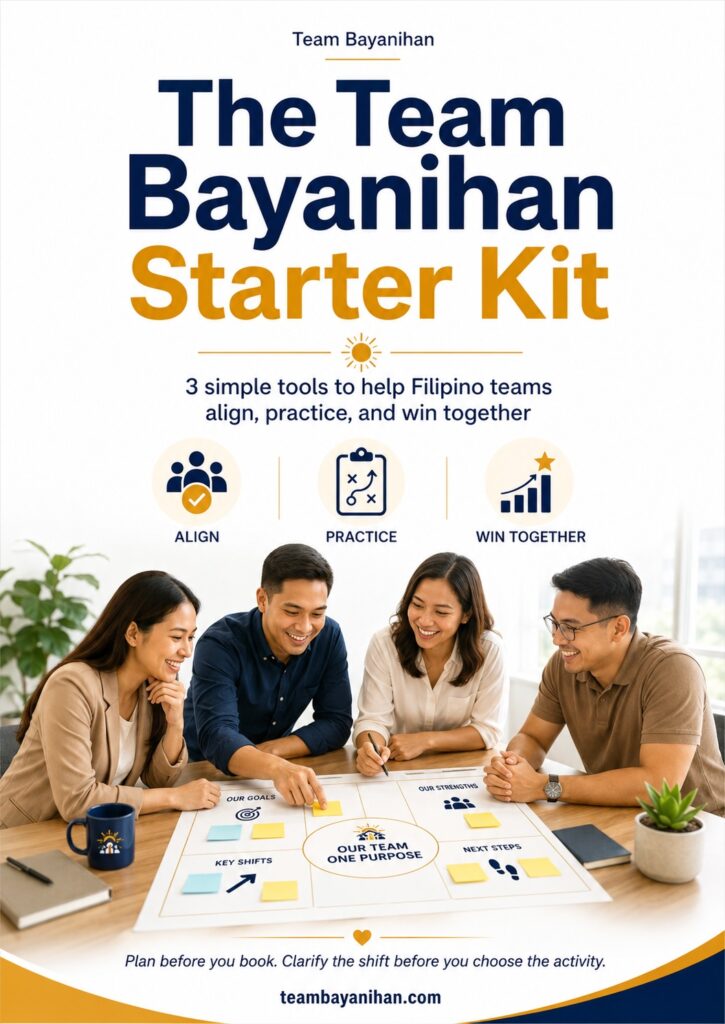
That is why Team Bayanihan created the Bayanihan Starter Kit.
It helps leaders, HR teams, and organizers think clearly before they plan. Inside, you’ll find simple tools to help you identify what your team really needs, avoid the usual team-building mistakes, and design an experience that leads to action.
Because team building should not end with photos. It should show up on Monday.
Team Building in El Nido: Get Your Team Out of the Room

200 Team Names for Workplace Team Building

40 Inspiring Team Building Quotes for Work

200 Best Hardwork Pays Off Quotes